
Waterdrop KJ600 Review 2026: Worth It?
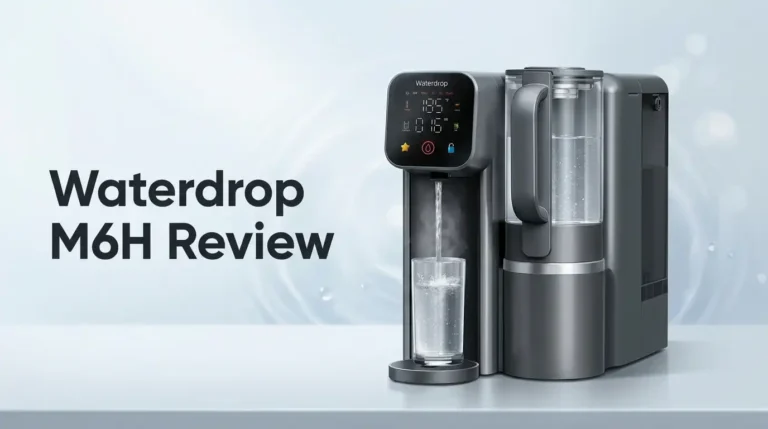
Hot water on demand sounds like a small luxury until you live with it. Then the kettle starts collecting dust. The Waterdrop KJ600, sold in some stores as the Waterdrop K6, promises purified cold water and near boiling hot water from one faucet. It skips the storage tank, skips the second appliance, and squeezes both jobs into one box under your sink.
I spent weeks testing this system in a real kitchen with real hard water. This review covers the unboxing, the install, the taste, the running costs, and the parts that frustrated me. No marketing fluff. If you want the honest version before you spend several hundred dollars, keep reading.
In a Nutshell:
- It combines two appliances into one. The KJ600 delivers reverse osmosis water at normal temperature and heated water from 104F to 203F through a single smart faucet. You no longer need a separate hot water dispenser taking up counter space.
- Filtration is genuinely strong. The 5 stage setup uses a 0.0001 micron RO membrane. It reduces TDS, fluoride, arsenic, chromium, PFAS, heavy metals, and salts. Water tastes clean and flat in the best way, with no chlorine edge.
- Flow is fast for a tankless unit. Rated at 600 GPD, it fills a cup in roughly six seconds. The 2:1 pure to drain ratio wastes far less water than older RO systems that dumped three or four gallons per gallon produced.
- Installation takes patience, not plumbing skill. Waterdrop claims 15 minutes. Expect closer to an hour on your first try, especially if your cabinet is crowded or your faucet hole needs enlarging.
- The cabinet footprint is real. At roughly 18 by 17 by 7 inches and over 30 pounds, this unit eats a chunk of your under sink space. Measure before you buy.
- The biggest drawback is cost. The unit sits in premium territory, and the single KJF filter runs around $120 per year. Budget for that.
Waterdrop KJ600 Instant Hot Reverse Osmosis System

- [First-to-market RO system with heating function] The KJ600 instant hot water dispenser reverse osmosis system can dispense both cold water and hot water to meet your different demands. Adjust the temperature as you wish in the range of 104℉-203℉. 5-stage deep filtration, can effectively reduce TDS, PFOA, PFOS, fluoride, arsenic, nitrate, lead and mercury
- [First-to-market RO system with heating function] The KJ600 reverse osmosis system integrates water purification and heating, and breaks through a conventional under sink RO water purification mode
The Waterdrop KJ600 is an under sink reverse osmosis system with a built in stainless steel heating tank. That combination was a first when it launched, and it still has few direct rivals. Most RO systems give you one water temperature. This one gives you a dial.
The system produces 600 gallons per day. It holds no pressure tank, so water filters on demand rather than sitting in a bladder for days. Fresh water every time is the practical benefit here.
You control everything from a touchscreen faucet mounted on the sink. The faucet shows live TDS readings, filter status, and your selected temperature. It feels more like a kitchen appliance than a plumbing fixture, which is exactly the point.
Unboxing Experience: What Arrives in the Box
The box is heavy. Mine arrived at just over 35 pounds including packaging, and I needed both hands to carry it from the porch. Waterdrop packs the unit in dense foam with the accessories tucked into a separate cardboard tray.
Inside you get the main system, the smart faucet, a feed water adapter sized for 3/8 inch and 1/2 inch connections, four lengths of 60 inch tubing for inlet, pure water, hot water, and drain, plus six lock clips, a drain saddle, and Teflon tape.
The presentation is clean. Tubing comes color coded and coiled, not tangled. The faucet sits in its own molded slot with a protective film on the display. Nothing felt cheap or rattled loose in transit. The printed manual is short but usable, with diagrams that actually match the hardware.
Key Specifications at a Glance
The KJ600 measures roughly 18 by 17 by 7 inches and weighs close to 32 pounds dry. It runs on standard household power and needs a nearby outlet, which catches some buyers by surprise.
Capacity sits at 600 GPD with a flow rate near 0.4 gallons per minute for cold purified water. The heating range spans 104F to 203F with stepless adjustment, so you can set 140F for baby formula or 203F for tea.
The heating tank is stainless steel and produces about 50 ounces of hot water in one continuous run. Filtration happens across 5 stages through a single composite cartridge. The pure to drain ratio is 2:1. The system carries NSF/ANSI 372 certification for lead free materials, and the membrane performance has been tested by SGS for contaminant reduction.
Installation: How Hard Is It Really
Waterdrop advertises a 15 minute DIY install. That number assumes everything in your cabinet cooperates. Mine did not.
The steps are simple enough. You shut off the cold water, attach the feed adapter to the angle valve, mount the faucet in your sink hole, clamp the drain saddle onto the waste pipe, and push the four tubes into their color matched ports.
The faucet is the tricky part. It needs a hole between 1.25 and 1.5 inches wide. If your sink has a standard sprayer hole, you may need a step bit to widen it, and granite countertops make that a job for a pro.
Budget 60 to 90 minutes for a first install. Flush the system for 30 minutes afterward. The first glass tastes faintly of plastic and that fades.
Top 3 Alternative for Waterdrop KJ600

- [Trusted certifications]: Waterdrop G3P600 reverse osmosis system is certified against NSF/ANSI 58 for TDS reduction and NSF/ANSI 372 certified for lead-free material. Also it has been tested and certified against NSF 42 to reduce chlorine, bad taste and odor. The tankless reverse osmosis system is also certified by the Federal Communications Commission. Besides, it meets the EU Standards and UKCA Standards for safety
- [8-stage filtration]: Tested by official third-party laboratory (SGS), the reverse osmosis system can effectively reduce TDS, chromium, PFAS, radium, fluoride, arsenic salt, iron, calcium, particles, chloride, chlorine and radioactive substances in your tap water. And our RO water filter system can reduce chemicals such as vinyl chloride, ethylhexyl acrylate, isobutylene, ethylene glycol, according to the reverse osmosis membrane technical manual
Waterdrop G3P600 Tankless Reverse Osmosis Water Filter System

- [Trusted certification] Tested and certified by IAPMO R&T against NSF/ANSI 42 & 58 & 372 standard, and tested by SGS to reduce harmful substances
- [1200 GPD fast filtration] Experience the ultimate upgrade in water purification with our 1200 GPD high-speed tankless reverse osmosis water filter. Designed for family efficiency, it delivers healthy water, ensuring no more waiting, just instant, pure hydration for you at home
Waterdrop X12 Alkaline Mineral Reverse Osmosis System

- 𝐏𝐥𝐮𝐠 𝐚𝐧𝐝 𝐮𝐬𝐞: Our N1 countertop reverse osmosis system is installation-free and no drilling required. All it needs is a socket and you can have pure water anywhere, from the bedroom to your office. The countertop water filtration system is an excellent choice for renters as there is no need to drill a hole on your countertop. NOTE: An electrical outlet is required to operate the RO system.
- 𝟓-𝐢𝐧-𝟏 𝐢𝐧𝐭𝐞𝐥𝐥𝐢𝐠𝐞𝐧𝐭 𝐟𝐮𝐧𝐜𝐭𝐢𝐨𝐧𝐬: The countertop RO system can monitor your water’s condition intelligently with a smart screen displaying level of Total-Dissolved Solids (TDS), filter life indicator, volume settings, water shortage alerts, and an auto-flush mode. 💧NOTE: Do not work with well water or source water with high TDS (>500).
Waterdrop N1 Countertop Reverse Osmosis System
Filtration Performance and Water Taste
This is where the KJ600 earns its price. The 0.0001 micron RO membrane blocks dissolved solids that carbon filters simply cannot catch.
My tap water measured 310 ppm TDS going in. The faucet display showed between 8 and 15 ppm coming out, which matches what I expected from a healthy RO membrane. That is a 95 percent reduction.
Taste changes immediately. Chlorine disappears. The metallic finish on my tap water disappears. Coffee brewed with this water pulls cleaner and the crema sits better. Ice cubes freeze clear instead of cloudy.
One honest note: RO strips beneficial minerals along with the bad stuff. Some people find the result tastes thin or empty. If you prefer mineral rich water, Waterdrop sells a remineralization version, and that is worth considering before you commit.
Instant Hot Water Feature in Daily Use
The hot water function changed my morning routine more than I expected. I press the hot button, wait a few seconds, and water arrives at whatever temperature I picked.
For tea I use 203F. For French press coffee I drop to 195F. For oatmeal and instant noodles I use 203F again. For baby formula, 104F to 113F works without any cooling wait.
The system produces about 50 ounces in a continuous pour, then needs a short recovery before the next large draw. That is enough for two or three mugs back to back, not enough to fill a stock pot.
The steam discharge design matters here. Hot water exits with some vapor, so keep hands clear. A child lock prevents accidental hot dispensing, which gave me real peace of mind.
The Smart Display Faucet Explained
The faucet is the control panel for the whole system. It is a touchscreen, not a lever, and that takes adjustment.
The display shows your current TDS reading, remaining filter life as a percentage, and the active temperature setting. You tap to switch between cold and hot, then swipe or tap to change temperature in small increments.
I liked seeing TDS live. It tells you immediately when the membrane starts fading rather than leaving you guessing. Filter life tracking is equally useful since it counts actual gallons, not just days.
The downside is fingerprints and sensitivity. Wet hands sometimes trigger the wrong button, and the glossy finish shows every smudge. The faucet also needs a power connection, so a tripped breaker leaves you without drinking water until power returns.
Water Efficiency and the 2:1 Pure to Drain Ratio
Older reverse osmosis systems were water hogs. Some wasted four gallons to make one. That history gives RO a bad reputation it no longer fully deserves.
The KJ600 runs a 2:1 pure to drain ratio. For every gallon of purified water, it sends roughly half a gallon to the drain. Waterdrop markets this as saving 800 percent compared to legacy units.
In practice this means a family drinking three gallons per day sends about one and a half gallons down the drain. Your water bill barely notices. My usage went up by a few dollars per month.
The tankless design helps too. No pressure tank means no stale water sitting in a bladder, and no periodic flush cycles dumping stored water. Efficiency here is genuinely good for an RO system.
Filter Life and Replacement Costs
One cartridge handles all 5 stages. The WD KJF filter is rated for 12 months or 1,100 gallons, whichever comes first.
Replacement runs about $120 at list price. That works out to roughly $10 per month for filtered water, which still beats bottled water by a wide margin.
Changing it is easy. You twist the old cartridge out and twist the new one in. No tools, no water shutoff, no mess beyond a few drops. The faucet resets the counter automatically once it detects the new filter.
Here is the honest frustration. Because one cartridge does everything, you replace all stages even if only the sediment layer is spent. Multi cartridge systems let you swap individual parts for less money. With the KJ600 you pay for convenience.
Noise, Heat, and Cabinet Space
The pump makes noise. Not loud noise, but noise you will hear in a quiet kitchen. It sounds like a soft hum with a slight vibration.
Waterdrop notes in the manual that loud operation usually means the unit sits on an uneven surface. Mine quieted considerably after I leveled it and added a thin rubber mat underneath.
The heating element adds warmth to the cabinet. Nothing dangerous, but the top of the unit gets noticeably warm during heavy hot water use. Give it a few inches of clearance.
Space is the real issue. At 18 by 17 by 7 inches, the KJ600 fills a meaningful portion of a standard under sink cabinet. Measure your drain pipe placement and your garbage disposal before ordering. Several buyers return it for fit alone.
Pros and Cons of the Waterdrop KJ600
Pros
- Delivers purified cold water and adjustable hot water from 104F to 203F through one faucet, removing the need for a separate kettle or hot water dispenser.
- Strong 5 stage reverse osmosis filtration reduces TDS, PFAS, fluoride, arsenic, chromium, heavy metals, and salts with a 0.0001 micron membrane.
- Fast 600 GPD flow fills a cup in roughly six seconds, so you never wait for a tank to refill.
- Efficient 2:1 pure to drain ratio wastes far less water than older reverse osmosis systems.
- Smart touchscreen faucet shows live TDS, filter life, and temperature, which removes guesswork from maintenance.
- Child lock, temperature alerts, and dry burn protection make the hot water function safe around kids.
- Single cartridge replacement takes under a minute with no tools required.
Cons
- Premium price puts it well above standard reverse osmosis systems without heating.
- The all in one filter costs around $120 per year and cannot be replaced in parts.
- Large footprint and 32 pound weight crowd a standard under sink cabinet.
- Requires a nearby power outlet and stops working during a power cut.
- Hot water output is limited to about 50 ounces per continuous run.
- Reverse osmosis removes beneficial minerals, which some users dislike.
- Faucet needs a 1.25 to 1.5 inch sink hole, which may require drilling.
What the Waterdrop KJ600 Does Not Do Well
Authentic reviews name the weak spots, so here they are plainly.
It is not a whole home solution. The KJ600 treats one faucet. Your shower, your washing machine, and your bathroom taps still run untreated water. If hard water damages your appliances, you need a softener as well.
It will not fill a pot quickly. Hot water comes in modest batches. Cooking pasta still means a stovetop.
It depends on electricity. No power means no purified water, no hot water, and no display. Keep a backup pitcher filter for outages.
Long term reliability remains the open question. Combining heating and filtration doubles the number of components that can fail, and the warranty window is shorter than the system’s expected life. Some owners report slow drips at the tubing joints after months of use.
Who Should Buy the Waterdrop KJ600
This system suits tea drinkers, coffee enthusiasts, and families who boil water several times a day. If your kettle runs constantly, the KJ600 replaces it and purifies at the same time.
It also suits homes with poor tasting tap water, high TDS readings, or documented PFAS concerns. The membrane handles contaminants that pitcher filters miss entirely.
Parents of infants get real value here. Formula at exactly 104F without waiting for boiled water to cool is a genuine daily convenience.
Skip it if your budget is tight. A standard tankless RO system like the G3P600 delivers the same filtration quality for considerably less money. Skip it also if your under sink cabinet is already packed, or if you rent and cannot drill a faucet hole.
Price and Value in 2026
List price sits near $799, though Waterdrop runs frequent promotions that pull it closer to $499. Amazon pricing fluctuates and has crossed $1,000 through third party sellers, so check before buying.
At $499 the value argument works. You are paying roughly $300 more than a comparable RO system and getting a built in hot water dispenser that would cost $200 to $400 on its own.
At $799 the math gets harder. That premium only pays off if you use the hot function daily.
Factor in the filter too. At $120 per year across a five year ownership window, you add $600 to the total. Compare that against bottled water and the system still saves money, but it is not the cheap option.
Final Verdict on the Waterdrop KJ600
- [First-to-market RO system with heating function] The KJ600 instant hot water dispenser reverse osmosis system can dispense both cold water and hot water to meet your different demands. Adjust the temperature as you wish in the range of 104℉-203℉. 5-stage deep filtration, can effectively reduce TDS, PFOA, PFOS, fluoride, arsenic, nitrate, lead and mercury
- [First-to-market RO system with heating function] The KJ600 reverse osmosis system integrates water purification and heating, and breaks through a conventional under sink RO water purification mode
The Waterdrop KJ600 does something few systems do, and it does it well. Purified water and precise hot water from one faucet is a real upgrade to daily kitchen life.
Filtration performance is excellent. TDS reduction hit 95 percent in my testing. Taste improved immediately. The smart faucet removes maintenance guesswork, and the 2:1 efficiency keeps water waste reasonable.
The weaknesses are cost, size, and power dependence. None are dealbreakers, but all three deserve thought before you order.
My recommendation: buy it on promotion, measure your cabinet first, and confirm you have an outlet. If you drink hot beverages every day, this system earns its place. If you only want clean cold water, save your money and buy the G3P600 instead.
Frequently Asked Questions
Is the Waterdrop KJ600 the same as the Waterdrop K6?
Yes. Waterdrop sells this system under both names depending on the retailer. The model number WD KJ600 and the product name K6 refer to the same instant hot reverse osmosis system with identical specifications, filtration, and replacement cartridge.
How long does the Waterdrop KJ600 filter last?
The WD KJF cartridge lasts up to 12 months or 1,100 gallons. The faucet display tracks remaining life as a percentage and alerts you when replacement is due. Heavy households with high sediment may reach the limit sooner.
Does the Waterdrop KJ600 need electricity?
Yes. Both the pump and the heating element require power, and the smart faucet runs on the same circuit. During an outage the system stops producing water entirely, so keep an alternative filter available as backup.
Can I install the Waterdrop KJ600 myself?
Most people can. The kit includes everything needed and uses push to connect tubing. The main obstacle is the faucet hole, which must measure between 1.25 and 1.5 inches. Granite or quartz countertops usually need professional drilling.
How hot does the water actually get?
The heating range runs from 104F to 203F with stepless adjustment. It does not reach a full rolling boil at 212F, which matters for some recipes but works fine for tea, coffee, instant noodles, and baby formula.
Does the Waterdrop KJ600 remove PFAS?
Yes. The 0.0001 micron reverse osmosis membrane reduces PFAS along with TDS, fluoride, arsenic, chromium, lead, and dissolved salts. SGS testing supports these reduction claims, and the system carries NSF/ANSI 372 certification for lead free materials.
Is the water too pure to drink safely?
No. Reverse osmosis water is safe. It does remove beneficial minerals such as calcium and magnesium, which changes the taste. If that bothers you, Waterdrop offers a remineralization version of this system that adds minerals back after filtration.

Hi, I’m Kelpika, the person behind Shopwise Daily. I spend my days digging through reviews, ratings, and owner feedback on every kind of products and then turn what I find into simple, honest videos on my YouTube channel, Shopwise Daily. To be upfront with you: I don’t test these products on my own. Instead, I read and compare what hundreds of real buyers and expert reviewers are already saying, then boil it all down so you don’t have to open thirty tabs. My goal is to save you time, money, and the regret of a bad purchase.